
Description
Ultrasound-Guided Regional Anaesthesia (UGRA)
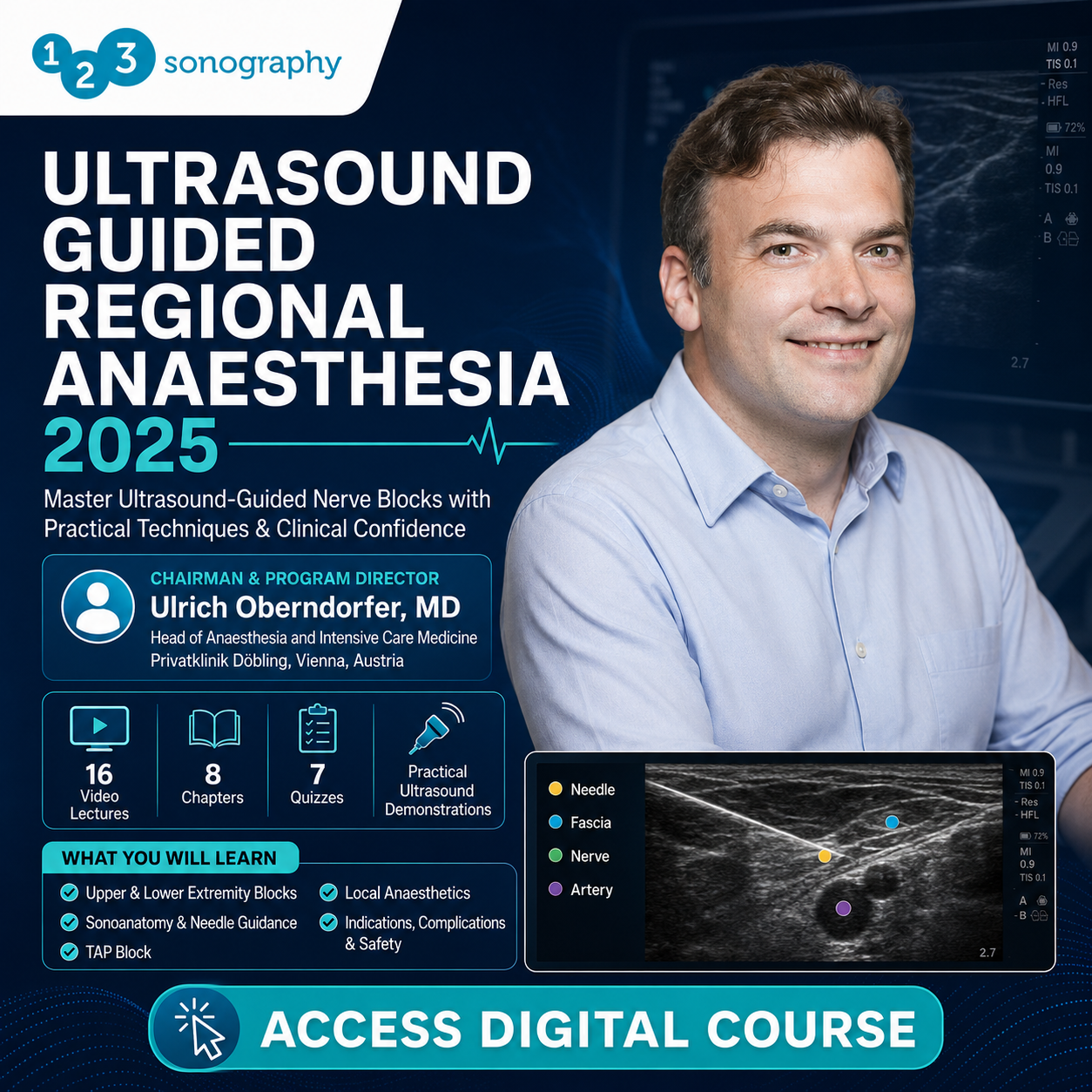
The Ultrasound-Guided Regional Anaesthesia (UGRA) course is a comprehensive, CME-accredited educational program designed for healthcare professionals at all levels of experience who wish to develop or refine their skills in regional anaesthesia.
This course provides a structured, step-by-step approach to the principles and practice of ultrasound-guided nerve blocks. Through expert-led lectures and live sono-anatomy demonstrations, participants gain the practical knowledge required to safely and effectively perform the most commonly used UGRA techniques in daily clinical practice.
The curriculum covers:
-
Fundamentals and history of regional anaesthesia
-
Ultrasound physics, machine settings, and nerve imaging
-
Safe needle and cannula approaches
-
Upper extremity nerve and plexus blocks
-
Lower extremity nerve blocks
-
Transversus Abdominis Plane (TAP) block
-
Local anaesthetics, adjuvants, dosing, and side effects
The course is organized into 8 comprehensive chapters, including 16 video lectures and 7 quizzes to reinforce learning and assess knowledge acquisition. A set of free introductory lectures is included to provide an overview of key concepts and common pitfalls in ultrasound-guided regional anaesthesia.
Course Structure
-
CME Credits: 0
-
Chapters: 8
-
Lectures: 16
-
Quizzes: 7
-
Free Introductory Content: Included
Course Chapters & Topics
Chapter 1 – Free Lectures
-
Introduction to Ultrasound-Guided Regional Anaesthesia
-
Key teaching points
-
Common pitfalls in UGRA
Chapter 2 – Introduction
-
History of regional anaesthesia
-
Evolution of ultrasound-guided techniques
-
Advantages and limitations of UGRA
-
Indications and complications
Chapter 3 – Imaging Nerves
-
Ultrasound basics and nerve imaging
-
Anatomical overview
-
Ultrasound machine components and settings
-
Anisotropy
-
Individual sono-anatomy variability
-
AI technology in UGRA
Chapter 4 – Cannula Approaches
-
In-plane and out-of-plane techniques
-
Needle and cannula visualization
-
Safety principles
Chapter 5 – Upper Extremity Blocks
-
Brachial plexus anatomy
-
Interscalene block
-
Supraclavicular block
-
Axillary block
-
Ulnar, median, and radial nerve blocks
-
Indications and complications
Chapter 6 – Lower Extremity Blocks
-
Femoral nerve anatomy
-
Femoral nerve block
-
Adductor canal block
-
Saphenous nerve block
-
Sciatic nerve block
-
Indications and complications
Chapter 7 – TAP Block
-
Abdominal wall sono-anatomy
-
Transversus Abdominis Plane block technique
-
Indications and complications
Chapter 8 – Local Anaesthetics
-
Types of local anaesthetics
-
Concentrations and dosing
-
Adjuvants
-
Side effects and safety
Reviews
There are no reviews yet.